Hortense “Tee” Beveridge
1923-1993
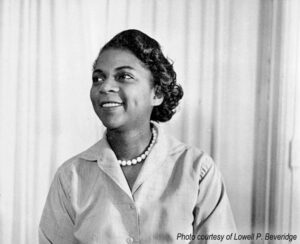
In 1947, Hortense “Tee” Beveridge was admitted to Hunter College. She majored in social work and became a mentee of the CNA (Committee for the Negro in the ARTS) which was the beginning of her film education. She then attended two semesters of night school film classes at New York University and made the acquaintance of fellow female film editor Peggy Lawson (with whom she would go on to collaborate over many years).
Beveridge’s political activism in the late 1940s led her to join the Council on African Affairs (CAA)—an outgrowth of the International Committee on African Affairs, cofounded in 1937 by Max Yergan and Paul Robeson—where she merged her political activities with her nascent filmmaking skills. The CAA provided Beveridge with the opportunity to edit her first known complete film, South Africa Uncensored (1951), a twenty-two-minute polemic against apartheid that was distributed by the Council.
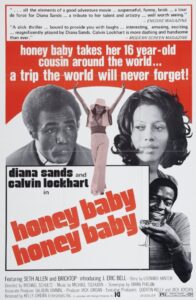
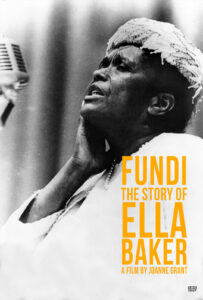
She was first black woman admitted to Local 771, the union for motion picture film editors, during the mid-1950s. During the next thirty years, Beveridge worked in three areas of film production (sometimes being credited with her maiden name, Hortense Sie). She cut featurette “making-of” documentaries about commercial films like Bullitt (1968), Mean Streets (1973), and The Outlaw Josey Wales (1976); she edited feature narrative films, including Honeybaby, Honeybaby (1974) by Michael Schultz; and edited documentaries like Amiri Baraka’s The New-Ark (1968), Joanne Grant’s Fundi: The Story of Ella Baker (1981), about the great civil rights activist, and Bittersweet Survival: Southeast Asian Refugees in America (1982) by Christine Choy and J. T. Takagi.
Beveridge also mentored St. Clair Bourne, Kathleen Collins, and John Killens at various early stages of their careers. – Thanks to Mike Jones and Walter Forsberg for their research.
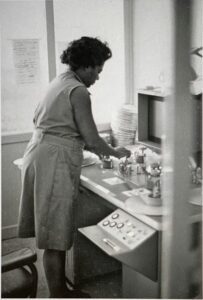
As Walter Hess recalls: “I was part of that leftist group. MPO Television Films employed a great number of what you would call leftists, as did several other companies that did similar work. Hortense and I were companions, working next to each other in the cutting room. There was only one other African American editor that I can think of at that time. They were incredibly rare. Tee had a very fine reputation as an editor, especially among that group of leftists. As far as I was concerned, Tee was very reserved. She was not ‘Hail fellow, well met.’ She was her own person, and I think the fact that she was black and a woman made her careful about what she might say or do.”
Please note: There are links to several of her films in the Appendix, courtesy of Ina Archer and the archive at the Smithsonian’s National Museum of African American History & Culture.